
Small-cap stocks can deliver powerful returns in a short time when traded correctly. Many beginner traders enter small-cap trading hoping for quick profits, but without a proper strategy, they often face sudden losses, emotional trading, and poor risk management.
The good news is that consistent weekly gains are possible if you follow a structured, disciplined trading system.
In this complete guide, you’ll learn:
- What small-cap stocks are
- Why they move fast
- The best trading setup for weekly profits
- Entry and exit strategies
- Risk management rules
- Common mistakes to avoid
- Tools and indicators beginners can use
This strategy is beginner-friendly and designed for traders who want steady growth instead of risky gambling.
What Are Small-Cap Stocks?
Small-cap stocks are companies with relatively smaller market capitalization compared to large-cap companies. In the Indian stock market, small-cap companies usually have:
- Higher volatility
- Faster price movement
- Lower institutional participation
- Greater growth potential
Examples of small-cap sectors include renewable energy, AI and technology, defense, chemicals, infrastructure, and emerging finance companies. Because of their lower market value, even moderate buying interest can create sharp price moves within days.
Why Small-Cap Stocks Are Ideal for Weekly Trading
Small-cap stocks often move 5% to 20% within a single week. This happens because:
- Lower liquidity increases momentum
- Retail traders participate heavily
- News impacts prices quickly
- Breakouts become explosive
Unlike long-term investing, weekly trading focuses on capturing short momentum swings. The goal is not to hold forever. The goal is to enter during momentum, protect capital, and exit with consistent profits.
Best Small-Cap Trading Strategy for Weekly Gains: The “Momentum Breakout + Volume” Strategy
This is one of the most effective strategies for consistent weekly gains. It works especially well in bullish or sideways markets.
Core Idea: Buy small-cap stocks when price breaks resistance, trading volume increases sharply, and market sentiment is positive. Then, hold for a few days, exit near target levels, and protect your downside with a stop loss.
Step 1: Find Strong Small-Cap Stocks
Choose stocks with strong recent momentum, good trading volume, positive news or sector strength, and a price above the 20-day moving average.
❌ Avoid: penny stocks with zero fundamentals, stocks with operator manipulation, and extremely low-volume shares.
Best Sectors for Small-Cap Momentum
In 2026, these sectors are attracting strong interest:
| Sector | Why It Moves Fast |
|---|---|
| Renewable Energy | Government support & green energy transition |
| Defense | Rising domestic and export contracts |
| AI & Technology | High future growth and disruption |
| Railways & Infra | Heavy infrastructure spending and upgrades |
| Chemicals | Growing export demand |
| Power & EV | Long-term commercial expansion |
Focus on sectors where institutional money is flowing.
Step 2: Use the Right Time Frame
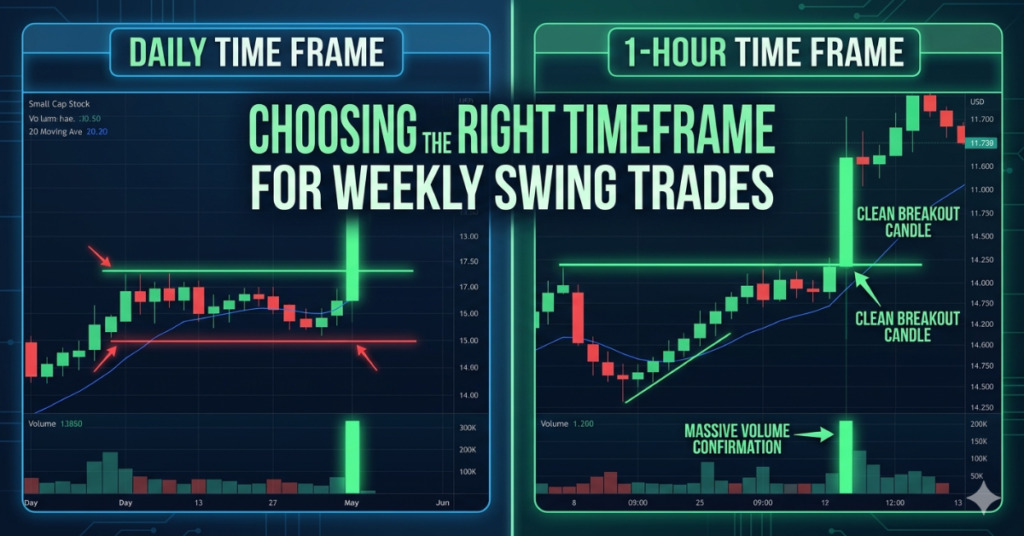
For weekly trading, use a daily chart to find the overall trend and a 1-hour chart to time your entry. The ideal holding period is 2 to 7 trading days. This avoids excessive overnight market stress while still capturing the core momentum move.
Step 3: Identify a Breakout
A breakout happens when a stock’s price crosses a strong resistance level.
Signs of a Good Breakout:
- A strong, wide-range green candle closing above resistance
- A massive volume spike at the bottom of the chart
- Overall bullish market sentiment
💡 Example: If a stock traded tightly between ₹95 and ₹100 for several weeks and suddenly moves above ₹100 with high volume, it may start a new momentum rally. That is where disciplined traders look for entry.
Step 4: Confirm With Volume
Volume is the most important confirmation tool. A breakout without supporting volume often turns into a “bull trap” (fake breakout). Look for a strong volume rule where volume is 2x or 3x higher than its 20-day average. This indicates real institutional or heavy retail buying interest.
Step 5: Entry Strategy
- Conservative Entry: Enter after the breakout candle closes and the next candle sustains above the resistance level. (Highly recommended for beginners).
- Aggressive Entry: Enter during the breakout candle itself the moment volume confirms the spike.
Step 6: Stop Loss Strategy
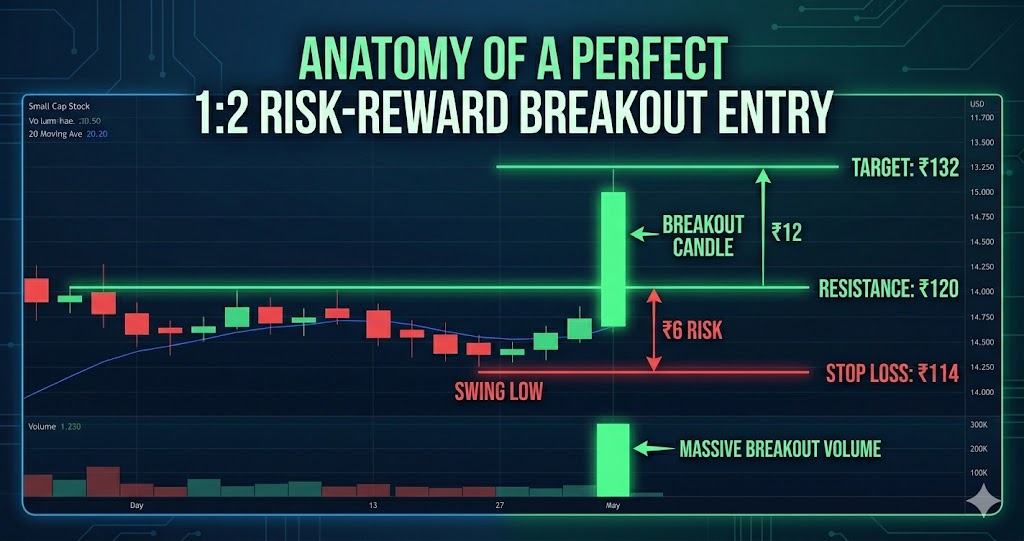
Risk management is the secret behind consistent weekly profits. Never trade without a stop loss. Place your stop loss below the breakout level or below the recent swing low.
- Example Entry: ₹120
- Stop Loss: ₹114
- Risk per share: ₹6
Step 7: Profit Booking Strategy
Do not become greedy. Weekly trading is about generating regular, predictable income.
- Ideal Target: Aim for a 1:2 risk-reward ratio minimum. If your risk is ₹6, your profit target should be at least ₹12 (Exit at ₹132).
- Trailing Stop Loss: Once the stock moves significantly higher, shift your stop loss upward to lock in profits.
Best Technical Indicators for Small-Cap Trading
- Volume Indicator: The absolute most important indicator for validating structural breakout confirmation.
- 20 EMA (Exponential Moving Average): Helps identify short-term trends. If the price stays above the 20 EMA, the short-term momentum remains aggressively bullish.
- RSI (Relative Strength Index): Look for an RSI above 60 for strong bullish momentum, but be cautious if it pushes deep into overbought extremes without strong volume backing it up.
Your Weekly Trading Routine
[Monday] ───► Find strong momentum stocks & build your watchlist.
[Tuesday] ──► Wait patiently for explicit breakout and volume confirmation.
[Wed-Thu] ──► Manage your active trades and trail stop losses upward.
[Friday] ───► Book profits before the weekend if momentum begins to weaken.
Risk Management Rules Every Trader Must Follow
- Never Risk More Than 2% Per Trade: Protecting your trading capital is far more important than chasing potential profits.
- Diversify: Do not put 100% of your trading account into a single small-cap stock.
- Avoid Overtrading: Limit your active trades. Too many simultaneous trades create chaotic, emotional decisions.
- Follow Proper Position Sizing: Trade with smaller amounts initially. Consistency matters far more than hit-or-miss big wins.
Ideal Trading Hours: Execute your trades between 9:45 AM and 11:30 AM. Avoid the absolute first 15 minutes of the market open (9:15 AM to 9:30 AM) due to extreme, erratic volatility.
Common Mistakes Beginners Make
- Buying Random Tips: Never buy a stock based on random WhatsApp, Telegram, or social media tips.
- Ignoring Volume: Low-volume breakouts almost always fail.
- No Stop Loss: Trading without protection will destroy your entire trading capital quickly.
- Holding Losing Trades: Cut your losses early. Never turn a short-term momentum trade into a long-term forced investment.
Swing Trading vs. Intraday Trading
| Feature | Swing Trading (Weekly) | Intraday Trading (Daily) |
|---|---|---|
| Stress Level | Lower; plenty of time to react | High; split-second choices |
| Suitability | Ideal for beginners & part-timers | Requires dedicated experience |
| Screen Time | A few check-ins a day | High screen time all day |
| Brokerage Cost | Lower impact on net profits | High cumulative brokerage charges |
For most beginners, weekly swing trading in small-caps is structurally safer and far more manageable than chaotic intraday trading.
Best Tools for Small-Cap Traders
- Chart Platforms: TradingView, Chartink, Investing.com
- Screeners: Set up custom filters for volume breakout, price above 20 EMA, and high relative strength.
- News Sources: Track corporate quarterly results, major government policies, and sector announcements.
Real-World Example of a Weekly Small-Cap Trade
Let’s look at a step-by-step example of how a disciplined trade plays out:
- Stock Setup: A small-cap railway stock has been consolidating sideways near ₹150 for two weeks.
- Breakout: The price suddenly breaks through the ₹150 resistance level, and the volume jumps 3x above average.
- Entry: You buy conservatively at ₹152 once the breakout candle closes.
- Stop Loss: Placed safely at ₹145 (below the recent consolidation support).
- Target: Set at ₹166 to maintain a clean 1:2 risk-reward ratio.
- Outcome: The stock hits ₹166 in 4 trading days. Risk = ₹7 | Reward = ₹14.
How Much Capital Do You Need?
Beginners can start small. A suggested starting capital of ₹5,000 to ₹25,000 is perfect. Focus entirely on mastering the setup, building discipline, and executing risk management rules. Throwing large amounts of capital at the market without skill always leads to painful losses.
Final Thoughts
The best small-cap stock trading strategy for consistent weekly gains is not about guessing, gambling, or prediction—it is about trading a system.
By filtering for strong momentum, confirming your breakouts with heavy volume, managing your downside risk strictly, and following a repeatable routine, you remove the emotion that breaks most retail traders. Start with small positions, track your results in a trading journal, and build your consistency week after week.