Introduction
Indian equity markets ended Thursday’s session on a weak note as global oil supply concerns rattled investor sentiment. Rising geopolitical tensions near the Strait of Hormuz, one of the world’s most important crude transport routes, pushed international oil prices higher and triggered selling pressure across major indices. As a result, both the Nifty 50 Index and the BSE Sensex closed lower on March 12, 2026, reflecting growing global uncertainty and cautious investor sentiment.
Market Data
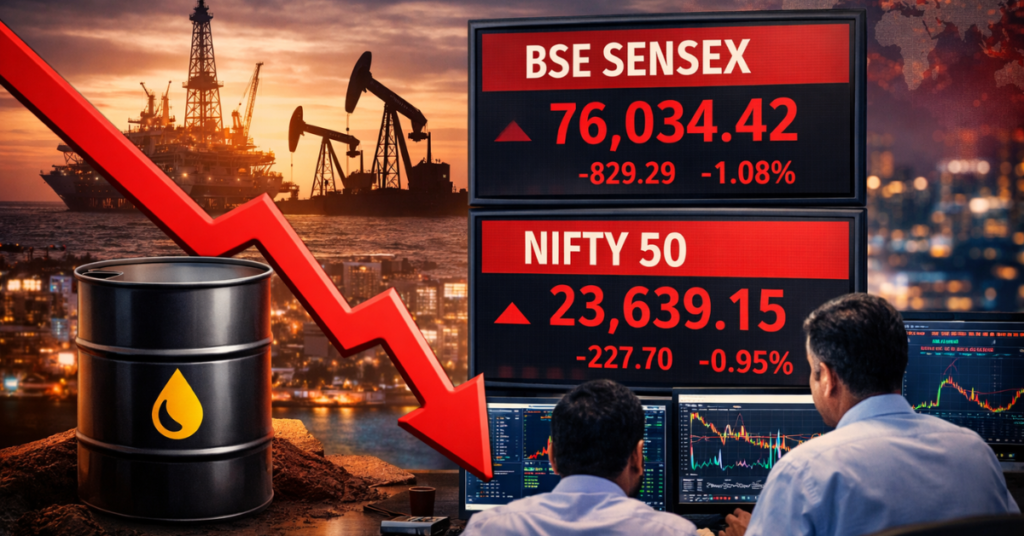
At the end of the trading session, the Nifty 50 Index settled at 23,639.15, down 227.70 points (-0.95%), while the BSE Sensex closed at 76,034.42, falling 829.29 points (-1.08%). Several sectors, including banking, auto, and aviation stocks, witnessed selling pressure during the day. Market participants remained cautious as higher crude prices could increase input costs and inflation, which may affect corporate earnings in the coming quarters.

Analysts believe that concerns about possible disruptions in oil supply through the Strait of Hormuz have been a major factor behind the recent surge in global crude prices. Since India imports a significant portion of its energy needs, any sustained rise in oil prices can negatively impact the economy by increasing fuel costs and inflation.
Additionally, global investors remained cautious amid geopolitical uncertainties, leading to intermittent selling in equities. Experts suggest that markets may remain volatile in the short term as traders continue to track geopolitical developments and global commodity prices.

Conclusion
In conclusion, rising geopolitical tensions and concerns over oil supply disruptions weighed heavily on Indian stock markets today. Investors will closely monitor global developments, crude oil prices, and foreign investment trends to assess the market’s next direction. Until global tensions ease, market volatility is expected to remain elevated.