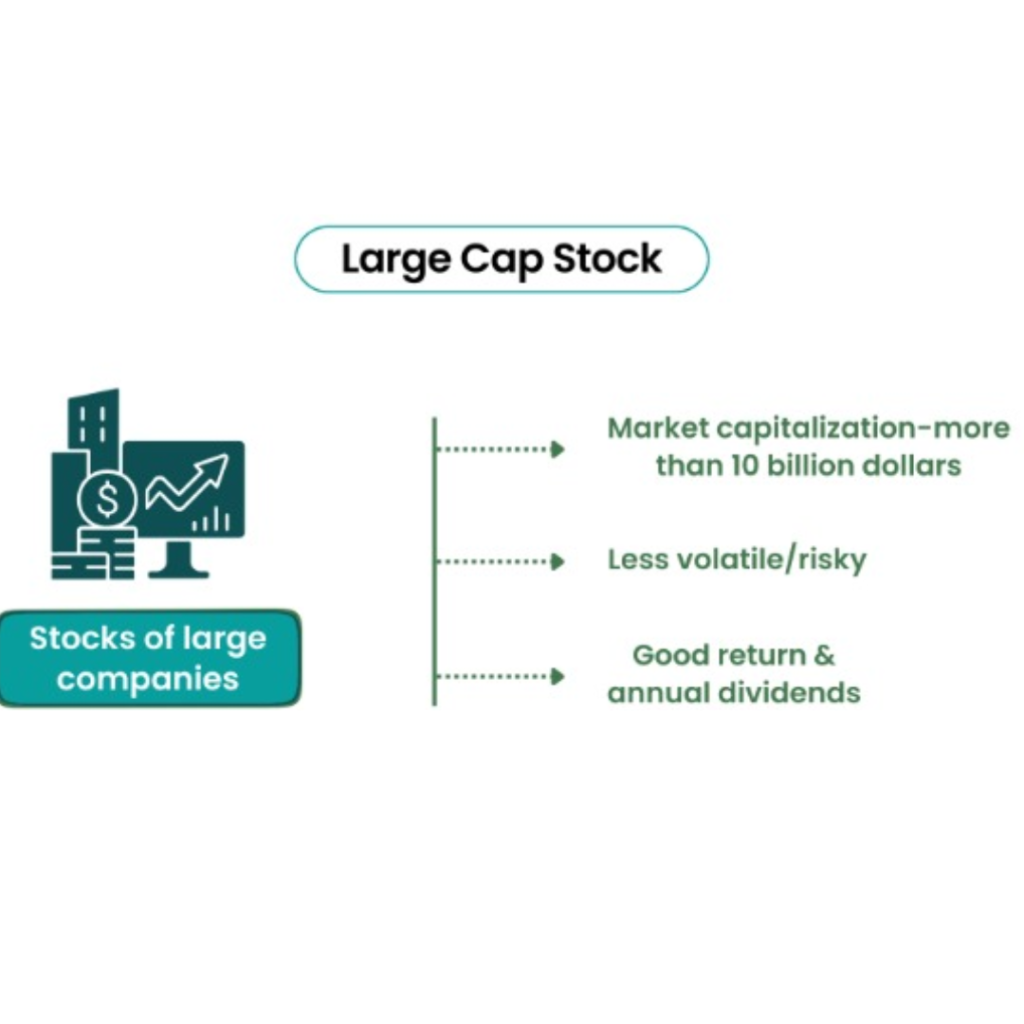
Large-cap stocks are the big, well-established companies of the stock market. They are often called blue chips because they usually have strong business models, high brand trust, and consistent demand for their products or services.
In India, the official definition used for mutual fund categorization is simple: large-cap companies are ranked 1 to 100 by full market capitalization (the list is prepared/published via AMFI as per SEBI’s framework).
If your goal is lower risk + steady returns (instead of “quick money”), large-caps are often the first category most long-term investors start with.
What are large-cap stocks?
A stock becomes “large-cap” when the company is among the top 100 listed companies by market capitalization (as per SEBI’s categorization framework used for equity mutual fund universes, with AMFI publishing the list).

What is market capitalization?
Market cap = Share Price × Total number of shares.
So, if a company’s market cap is very large, it usually means:
- many investors track it.
- it’s widely owned,
- and it’s traded actively (higher liquidity).
Large caps often dominate popular indices. For example, the NIFTY 50 is designed to represent large, leading companies across sectors on the NSE.
Why do investors like large caps for “steady returns”?
Large-caps are not “risk-free” (no stock is), but they are widely preferred for stability because many of them have:
1) Strong businesses with predictable demand
Large-cap companies often sell products/services that people and businesses need regularly:
- banking and payments
- telecom
- FMCG (daily essentials)
- power/energy
- IT services (global demand cycles affect them, but many remain leaders)
A strong business does not guarantee stock returns every month, but it reduces the chance of extreme surprises compared to weaker companies.
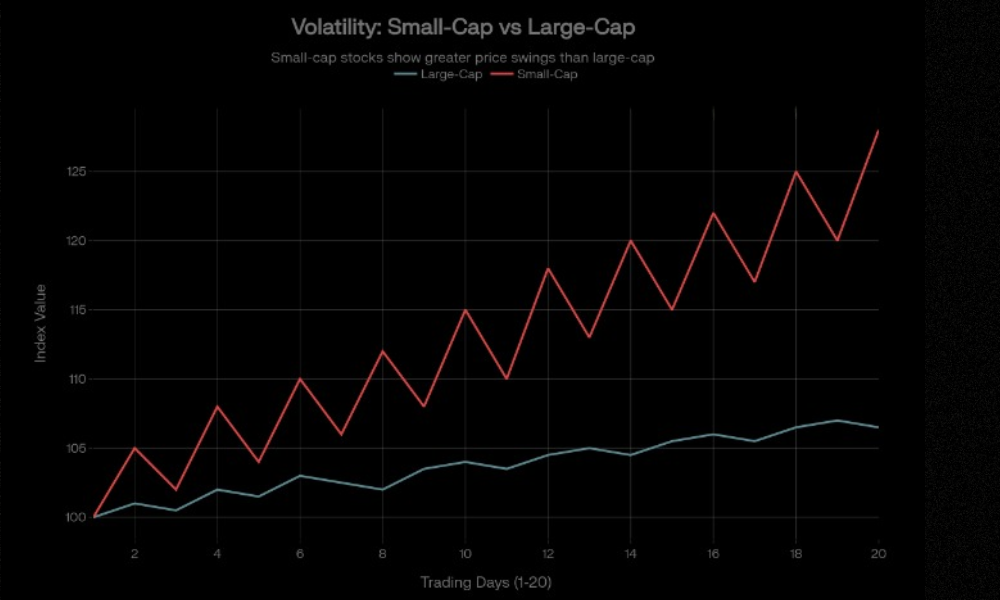
2) Lower volatility compared to smaller companies
In falling markets or panic sessions, small- and mid-cap stocks can fall sharply due to low liquidity and high speculation. Large-caps often hold up better because:
- more institutional ownership,
- higher daily trading volume,
- and stronger balance sheets.
3) Better liquidity (easy entry and exit)
When you buy a liquid stock, you can usually exit quickly near the market price. Large caps typically have:
- tighter bid-ask spreads,
- higher volumes,
- and consistent participation by institutions.
This matters a lot for retail investors because a “good” profit on paper is useless if you can’t sell at that price.
4) Good corporate governance (generally)
Not perfect, but many large caps are under constant scrutiny by
- analysts,
- institutions,
- media,
- and regulators.
This tends to reduce “hidden risks” compared to unknown, illiquid companies (though fraud can happen anywhere).
5) Dividends (in many cases)
Many large caps pay dividends, which can support “steady return” style investing—especially if your goal is stability rather than maximum growth. (Dividend consistency varies by company.)
The main benefits of large-cap stocks (in simple words)
✅ Stability
Large caps can still fall, but they usually don’t behave like a roller coaster every week.
✅ Better survival power in bad times
During economic slowdowns, companies with strong cash flows and access to capital tend to manage stress better.
✅ Easier for beginners
Large-caps are researched widely, so it’s easier to learn fundamentals using available reports and analyst coverage.
✅ Suitable for SIP-style long-term investing
If you invest regularly (monthly/quarterly), large-cap exposure often makes the journey emotionally easier because volatility is lower than small-caps.
But are large caps always best? (Important reality check)
Large caps also have disadvantages:
❌ Slower growth compared to mid/small-caps
A giant company may not double fast. A mid-cap can sometimes grow faster because it is still expanding.
❌ Valuation risk
A “quality” company can still become a bad investment if you buy it at an extremely high valuation.
❌ Overconfidence risk
Many beginners assume large-cap equals guaranteed returns. It’s not.
Large-caps can underperform for years if:
- the sector is weak,
- earnings slow down,
- or the stock becomes overvalued.
So think of large caps as lower risk, not no risk.
Large-cap stocks vs mid-cap vs small-cap (quick comparison)
- Large-cap: stability + steady compounding, lower volatility
- Mid-cap: balanced—good growth but more volatility
- Small-cap: high growth potential but highest volatility and risk
This is why many long-term investors use large caps as the core of the portfolio and then add mid/small-cap exposure as a “satellite.”
When large-caps perform best (current market situations)
Even without trying to “predict” the market, there are common phases where large caps tend to be preferred:
1) When the market is volatile
During sharp up-down moves, investors often rotate to stability and liquidity. Large caps are usually the first choice.
2) During uncertainty (global cues, earnings season, events)
When there’s uncertainty—results season surprises, global risk-off moves, crude oil moves—large caps often get more attention because institutions feel safer there.
3) When interest rates are expected to fall gradually
In general, falling rates can support equities. Large caps—especially rate-sensitive sectors like financials—can benefit when growth expectations improve. (This depends on earnings and the economy.)
How to choose “good” large-cap stocks (simple checklist)
Use this simple checklist for your blog readers:
Step 1: Start with business quality
- Is the company a leader in its sector?
- Does it have a strong brand or network advantage?
- Is demand for its product/service likely to remain for 5–10 years?
Step 2: Check financial health (basic)
- Consistent revenue and profit trend (not one-time spikes)
- Reasonable debt (compare with peers)
- Good cash flow (important!)
Step 3: Valuation check (don’t overpay)
- Compare P/E and P/B with:
- company’s own history,
- and competitors.
A great company at a crazy price can give poor returns.
Step 4: Watch long-term red flags
- frequent promoter pledging (if applicable)
- sudden accounting changes
- too many unrelated diversifications
- repeated big “one-time” losses
Step 5: Prefer consistency over stories
For large caps, you’re usually investing for:
- predictable compounding,
- stability,
- and reliability.
Best ways to invest in large-caps (beginner-friendly)
Option A: Buy a few large-cap stocks directly
If you enjoy learning about businesses, you can build a basket of 8–12 large-cap companies across sectors.
Rule: diversify across sectors (don’t buy only banking or only IT).
Option B: Index funds / ETFs (easy and powerful)
Many beginners choose index investing because:
- simple,
- low cost,
- diversified.
Popular large-cap exposure often starts with indices like the NIFTY 50 or similar broad large-cap indices.
Option C: Large-cap mutual funds
If you want professional management, large-cap funds invest primarily in the large-cap universe (as defined in the SEBI framework).
Portfolio allocation idea (steady-return style)
A simple “steady” allocation (example) could look like:
- 60–80% large-cap / index
- 10–30% mid-cap
- 0–10% small-cap (optional for aggressive investors)
This is not financial advice—just a logical template many investors use to balance growth and stability.
Common mistakes beginners make with large-caps
- Buying only because it’s famous
A famous company can still be overpriced. - No diversification
Buying 5 banking stocks is not diversification. - Panic selling during corrections
Large caps can fall short-term. If your time horizon is long, focus on business quality. - Expecting “fast money”
Large caps are usually about compounding, not lottery-like returns.
Conclusion
Large-cap stocks are the foundation layer for many Indian investors because they combine:
- business strength,
- higher liquidity,
- and relatively lower volatility.
If you want steady returns with lower risk, building your core portfolio around large caps (or large-cap indices) is one of the simplest and most practical approaches. Just remember: stable doesn’t mean guaranteed—valuation, diversification, and patience still matter.
FAQ (add this to the bottom for SEO)
1) Are large-cap stocks safe?
They are generally less volatile than smaller stocks, but they can still fall.
2) How are large-cap stocks defined in India?
Typically as the top 1–100 companies by full market capitalization (framework used for MF categorization).
3) Are NIFTY 50 stocks large-cap?
Most NIFTY 50 companies are among India’s leading large companies and are used as a benchmark for large, liquid stocks.
4) Can I invest in large caps through SIP?
Yes—many people use SIP in index funds/ETFs or large-cap funds for long-term compounding.