Introduction to Mid-Cap Stocks
Investing in the stock market involves choosing between different types of companies based on their size, growth potential, and stability. Among these, mid-cap stocks hold a unique position. They are neither as stable as large-cap stocks nor as risky as small-cap stocks.
For long-term investors, mid-cap stocks frequently offer a mix between growth and risk. However, like any investment, they come with both advantages and disadvantages. This article explains mid-cap stocks in a simple, practical way so beginners and experienced investors alike can understand whether they fit their investment goals.
What Are Mid-Cap Stocks?
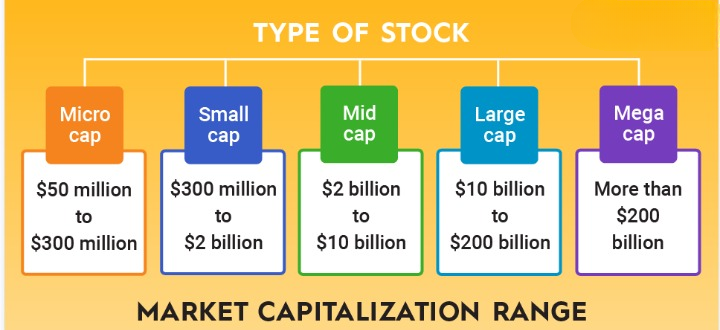
Mid-cap stocks are companies with a medium market capitalization, typically larger than small-cap companies but smaller than large-cap corporations.
These companies are usually:
Past their early startup phase
Still expanding their business
Actively increasing market share
Mid-cap companies often operate in growing industries and have the potential to become future large-cap leaders.
Why Investors Are Attracted to Mid-Cap Stocks
Mid-cap stocks attract investors because they combine growth potential with relative stability. Unlike small companies, many mid-cap firms already have proven business models while still having room to grow.
They often benefit from:
Expanding markets
Increasing revenues
Improved management maturity
Advantages of Mid-Cap Stocks
Higher Growth Potential Than Large-Cap Stocks
Mid-cap companies are still in their expansion phase. They often grow faster than large, established corporations because they are:
Entering new markets
Launching new products
Scaling operations
For long-term investors, this growth can translate into higher capital appreciation.
Better Stability Compared to Small-Cap Stocks
Unlike small-cap stocks, mid-cap companies usually have:
Established customer bases
More predictable revenue
Better access to funding
This makes them relatively safer than early-stage companies.
Opportunity to Become Future Market Leaders
Many well-known large companies today were once mid-cap stocks. Investing in strong mid-cap companies early can offer investors the chance to benefit from long-term business expansion.
Strong Long-Term Return Potential
Historically, mid-cap stocks have delivered attractive long-term returns during economic expansion phases. Their ability to grow faster than large companies often leads to superior performance over extended periods.
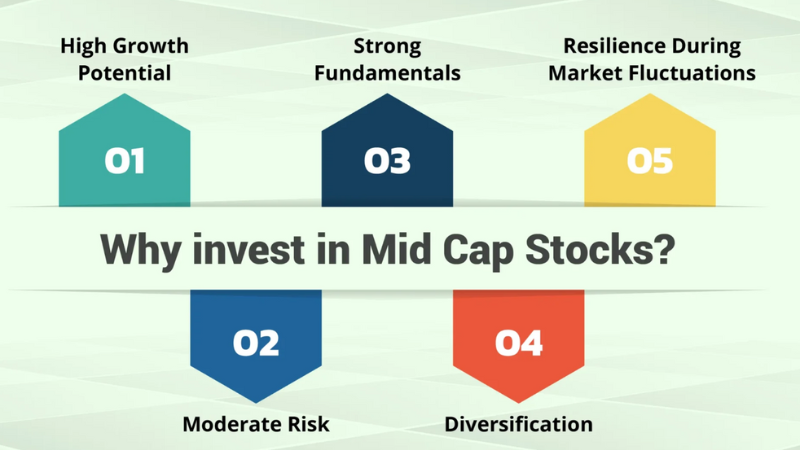
More Innovation and Flexibility
Mid-cap companies are often more flexible and innovative than large corporations. They can adapt faster to:
Industry changes
Technology shifts
Consumer demand
This agility gives them a competitive advantage.
Disadvantages of Mid-Cap Stocks
Higher Volatility Than Large-Cap Stocks
Mid-cap stocks tend to fluctuate more during market uncertainty. Their prices may fall sharply during:
Economic slowdowns
Market corrections
Global crises
This volatility can be uncomfortable for conservative investors.
Business and Execution Risk
Some mid-cap companies are still refining their business models. Poor management decisions or expansion failures can negatively impact performance.
Lower Liquidity Compared to Large-Cap Stocks
Mid-cap stocks may have:
Lower trading volumes
Wider bid-ask spreads
This can make entry and exit slightly more difficult during volatile markets.
Greater Sensitivity to Economic Conditions
Mid-cap companies may be more affected by:
Interest rate changes
Economic slowdowns
Industry-specific risks
Their earnings may decline faster during downturns compared to large-cap companies.
Mid-Cap Stocks vs Large-Cap and Small-Cap Stocks
Mid-cap stocks sit between stability and growth.
Large-cap stocks: Stable, lower growth, lower risk
Mid-cap stocks: Balanced growth and risk
Small-cap stocks: High growth potential, high risk
For diversification, mid-caps often play a crucial role in a balanced portfolio.
Who Should Invest in Mid-Cap Stocks?
Mid-cap stocks are suitable for:
Long-term investors
Investors with moderate risk tolerance
Investors seeking growth with some stability
They may not be ideal for short-term traders or extremely conservative investors.
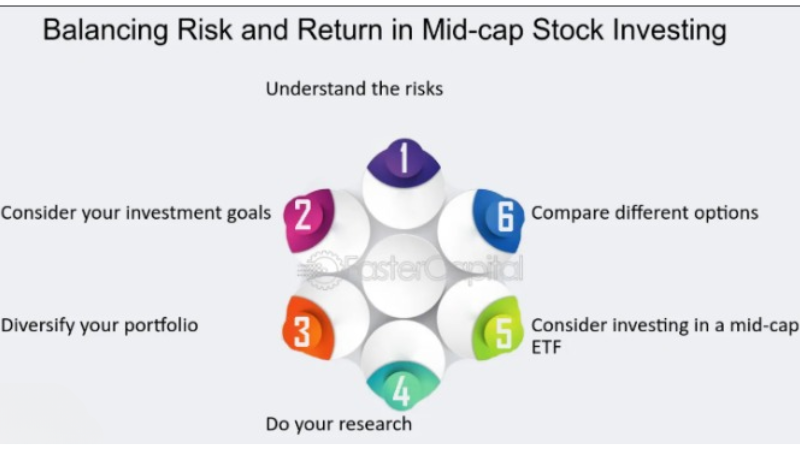
How to Reduce Risk While Investing in Mid-Cap Stocks: Diversification
Avoid investing in a single mid-cap stock. Spread investments across multiple sectors.
Long-Term Holding Approach
Mid-cap stocks perform best when held through market cycles. Short-term volatility should not influence long-term decisions.
Fundamental Analysis
Before investing, evaluate:
Company earnings
Debt levels
Management quality
Industry growth
Mid-Cap Stocks in a Long-Term Investment Portfolio
For long-term investors, mid-cap stocks can:
Enhance portfolio returns
Add growth exposure
Balance risk and reward
A well-structured portfolio often includes a mix of large-, mid-, and small-cap stocks.
Frequently Asked Questions
Are mid-cap stocks risky?
Mid-cap stocks carry moderate risk—higher than large-cap stocks but lower than small-cap stocks.
Are mid-cap stocks good for long-term investment?
Yes. Strong mid-cap companies can deliver excellent long-term returns if selected carefully.
How much should beginners invest in mid-cap stocks?
Beginners should allocate a limited portion of their portfolio and increase exposure gradually.
Final Thoughts:
The advantages and disadvantages of mid-cap stocks for long-term investors must be understood before investing. Mid-cap stocks offer an attractive blend of growth and stability, but they also come with volatility and business risks.
For investors willing to stay patient, diversified, and disciplined, mid-cap stocks can play a valuable role in long-term wealth creation.